The Best Namib Desert Photo Spots and When to Shoot Them

Namib Desert photography comes down to one clock, more than any lens or filter. The inner gate at Sesriem opens an hour before sunrise for guests sleeping inside the park, and that single hour decides whether your Deadvlei shot has a shadow line down the dune or a flat white pan under a climbing sun. This guide covers eight real spots, the clock window that matters at each, and the shots you can only get from a tour vehicle or a balloon basket.
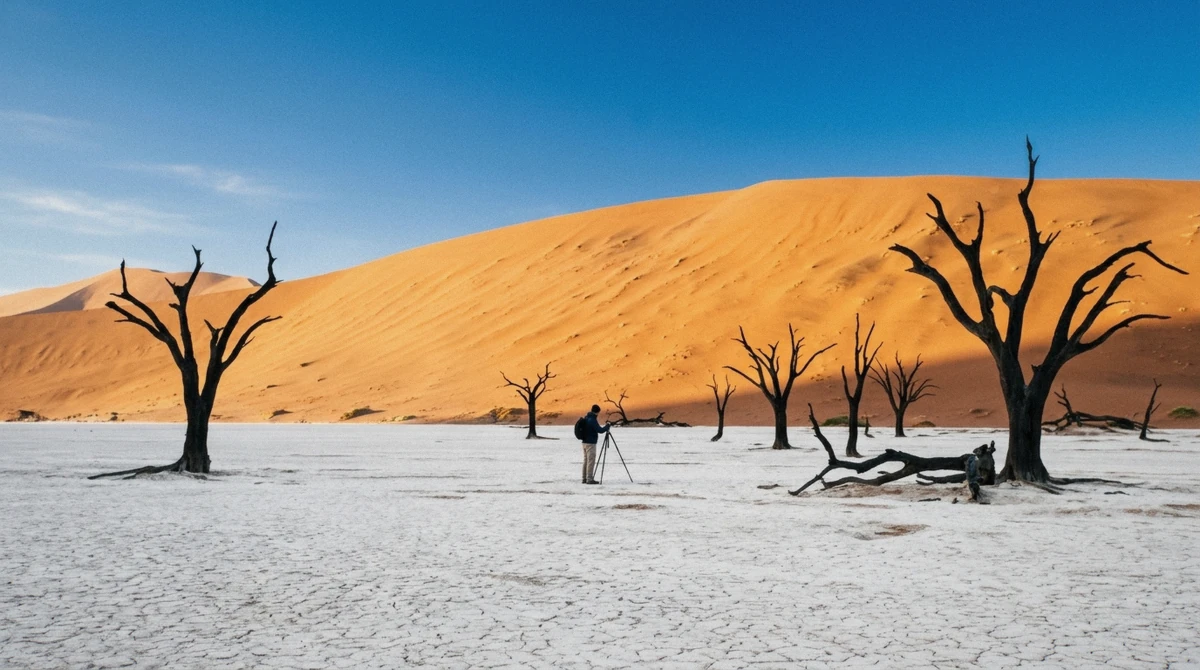
The first twenty minutes after the inner gate opens, the working window for every dune shot in this guide.
Quick answer
Deadvlei is the single best spot for Namib Desert photography, its dead camel thorn trees against an orange dune wall, but the best shot of the trip is usually the one you get from the tour vehicle itself, low sun raking across a dune face nobody stopped to photograph. Arrive through the inner gate at Sesriem to beat the light, and check the map below for the seven other spots worth the drive.
Key takeaways
- Best single spot: Deadvlei, shot in the first hour after the inner gate opens
- See the full map with all eight spots below, GPS included for each
- The shot from the tour vehicle or the balloon often beats anything shot on foot
- Timing matters more than gear here, arrive before the sun clears the dune line
- Drones need an environment ministry permit and are banned in the parks without one
- A phone with HDR handles dune contrast nearly as well as a camera in the right light
Namib Desert Photo Spots at a Glance
The Shortlist
Every spot in this guide, the shot it gives you, and how to reach it. The balloon gets its own row, since it is a category of photograph none of the ground spots can match.
| Spot | Best time | The shot you get | How to get there |
|---|---|---|---|
| 1. Sossusvlei | Sunrise to 08:00 | The pan floor with dunes reflected on the rare years it holds water | 60 km tar plus 6 km sand from the Sesriem gate |
| 2. Deadvlei | Sunrise to 08:00 | Dead camel thorn trees against an orange dune wall | Short walk from the 2x4 or 4x4 parking near Sossusvlei |
| 3. Dune 45 | 05:30 to 07:00 | A single sharp ridge line splitting light and shadow | 45 km mark on the road from Sesriem, roadside access |
| 4. Sesriem Canyon | 07:00 to 09:00 | Layered rock walls lit low into the gorge | 4 km from the Sesriem gate, an easy stop |
| 5. Elim Dune | Sunrise or last light | An accessible dune with almost no crowd | 5 km past the Sesriem gate, close to camp |
| 6. Sandwich Harbour | Low tide, any time of day | 100 m dunes dropping straight into the Atlantic | 42 km south of Walvis Bay, tour access only |
| 7. Walvis Bay Lagoon | Morning, high tide | Flamingo flocks against pink salt pans | Roadside pull-offs along the lagoon in Walvis Bay |
| 8. Swakopmund | Late afternoon fog line | The town's colonial edge against the desert behind it | Walkable within Swakopmund |
| From the balloon | First light, one hour aloft | The full dune sea from above, shadows still long | Sunrise launch near Sesriem, tour only |
Map of the Best Namib Desert Photo Spots
All eight spots, plotted with the access type that matters most when you are planning a shoot: reachable on your own, or tour and permit only.
The 8 Best Namib Desert Photo Spots
1. Sossusvlei
The shot: the clay pan floor stretching between two dune walls, with dunes reflected on the rare occasions the Tsauchab River reaches it. That flooding happens only every few years, usually between February and April, and no operator can promise it on a given trip.
Best time: arrive with the inner gate, which opens an hour before sunrise for guests sleeping inside the park at Sesriem Campsite, Sossus Dune Lodge, Dead Valley Lodge or Sesriem Oshana Campsite. That hour is the only reliable way to have the pan in first light before day visitors arrive through the outer gate at sunrise.
Getting there: 60 km of tar from the Sesriem gate to the 2x4 parking, then 6 km of deep sand to the pan itself, either in a 4x4 or via the private shuttle covered in full in our self-drive versus guided comparison. Sossusvlei tours run this route daily.
2. Deadvlei
The shot: the dead camel thorn trees, standing roughly 900 years since they died and never rotted because the air here is too dry for the fungi that break down wood, set against the deep orange face of the dune known as Big Daddy.
Best time: the same inner-gate hour that serves Sossusvlei. By mid-morning the light flattens across the white pan and the shadow definition that makes the trees photograph well disappears. Climbers who want the aerial view down onto the pan take on Big Daddy itself, 325 m of loose sand with 45 to 60 minutes up and about three minutes to run down into the vlei.
Getting there: a short walk from the 2x4 or 4x4 parking near Sossusvlei, about 2 km. No separate fee beyond the standard park permit.
3. Dune 45
The shot: a single sharp ridge line dividing the dune into sunlit and shadowed faces, the most photographed dune in the park precisely because its shape holds that line so cleanly.
Best time: 05:30 to 07:00. Dune 45 stands 80 m high at the 45 km mark on the road in from Sesriem, and the climb takes 20 to 30 minutes, which means an early arrival is the only way to be on the ridge, not still climbing it, when the light is best.
Getting there: roadside access directly off the route from Sesriem, no additional walk to the base.
4. Sesriem Canyon
The shot: layered rock walls, cut into conglomerate around 15 million years old, lit low along the gorge floor rather than from directly above.
Best time: 07:00 to 09:00, after the dune shots and before the midday sun flattens the canyon's contrast into a single tone.
Getting there: 4 km from the Sesriem gate, covered by the same park permit, with roughly 45 minutes needed to walk the accessible stretch of the canyon floor.
5. Elim Dune
The shot: a full dune face without the crowd that gathers at Dune 45, useful when the light works but the ridge line at the famous dune is already busy with other visitors.
Best time: sunrise, or the last hour before sunset, since the dune has no shade and no wind protection at any other point in the day.
Getting there: 5 km past the Sesriem gate, close enough to camp for a pre-dawn walk without a long drive first.
6. Sandwich Harbour
The shot: dunes roughly 100 m high dropping straight into the Atlantic, 42 km south of Walvis Bay, a combination that exists in very few places on earth.
Best time: set by the tide, not the clock. The beach route is the only way in and it opens for a few hours around low tide, which shifts about 50 minutes later each day, so the shooting window moves with it rather than repeating at a fixed hour.
Getting there: permit required and access restricted to licensed operators, no self-drive. Sandwich Harbour tours like the sunset photography tour build the drive around the light rather than the other way around.
7. Walvis Bay Lagoon
The shot: flamingo flocks, which peak near 50,000 birds, spread across the pink salt pans, with the lagoon holding over 150,000 birds in total and about 70% of the world's chestnut-banded plovers at points in the year.
Best time: morning, on a rising or high tide, when the birds feed closer to the accessible shoreline rather than out on the distant flats.
Getting there: roadside pull-offs along the lagoon within Walvis Bay itself, no permit needed for the shoreline view.
8. Swakopmund
The shot: the town's colonial-era buildings against the desert and the fog line that rolls in most evenings, a contrast unique to this stretch of coast.
Best time: late afternoon, when the fog begins its nightly push inland and the light turns soft rather than harsh.
Getting there: entirely walkable within Swakopmund, no vehicle or permit required.
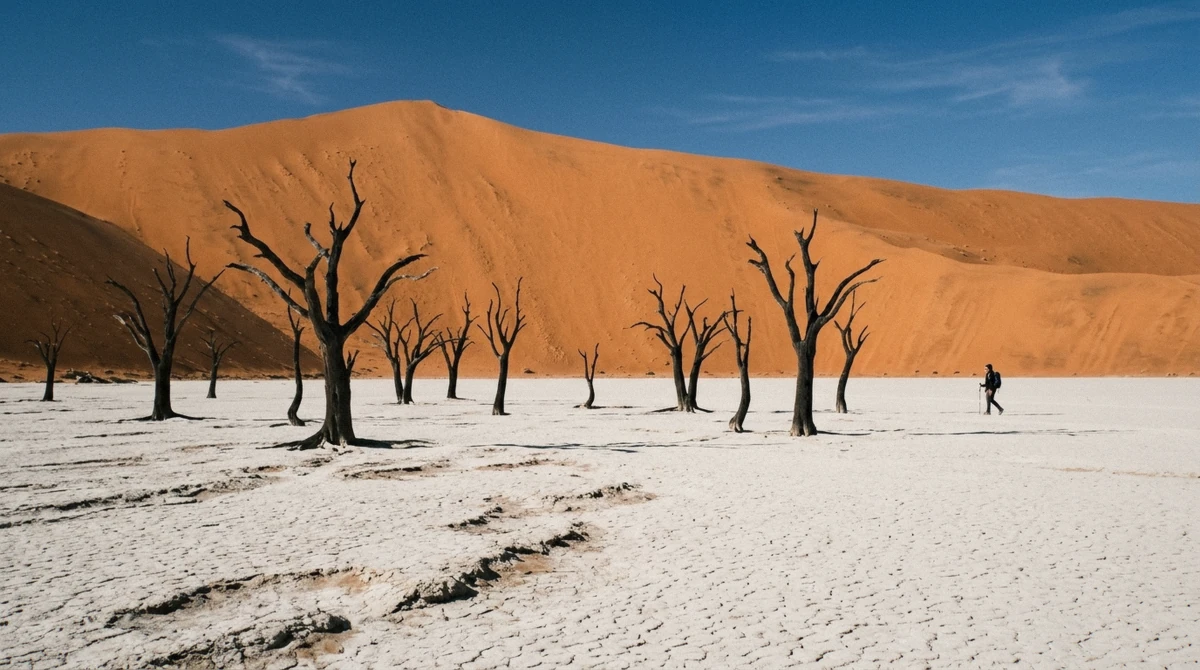
Deadvlei in the inner-gate hour, the shadow line that disappears by mid-morning.
Photos From the Tour Vehicle and the Balloon
The Shot You Cannot Get on Foot
Ground shots exist at every spot above, but the single best frame of a Namib trip is often the one taken moving. Roll the window down before your guide asks, glass reflections and dust film ruin more dune photographs than bad light does. A raised roof hatch or open-sided vehicle, common on the Etosha game drives and several Sandwich Harbour tours, gives a clean angle down a dune face that a fixed tripod on the ground cannot match.
The sunrise balloon over Sossusvlei is its own category entirely. An hour aloft at $1,087 puts the whole dune sea below you while the shadows are still long, oryx and springbok visible as small marks against the sand from altitude. The balloon circles slowly rather than holding one position, so patience beats jockeying for a spot along the basket rail, everyone gets a turn at the best angle before the flight ends.
On Sandwich Harbour runs, the beach approach itself photographs well from inside the vehicle, the ocean on one side and dune faces on the other in the same frame, a composition that only exists from the seat you are already sitting in.
Camera and Phone Settings That Work Here
What Actually Helps in This Light
Shoot early. The contrast between shadowed and sunlit dune faces that makes these photographs work exists only for a couple of hours after the inner gate opens, and no amount of editing recreates a shadow line that never formed.
Phone cameras handle dune contrast well with HDR left on, since the dynamic range between bright sand and dark shadow is exactly what HDR modes are built for. A polarizing filter on a dedicated camera cuts glare off the white pan at Deadvlei and deepens the sky without extra editing. Avoid digital zoom on a phone entirely, cropping afterward from a wide shot keeps far more detail.
Protect the gear more than you protect the shot. Sand works into zippers, ports and lens seams within minutes on a windy dune, so a sealed bag between shots matters as much as any setting choice. Spare batteries drain faster than expected in the cold pre-dawn air at Sesriem, keep one in an inner pocket rather than a cold camera bag.
A short honesty note on the images in this guide: they are shot straight, with light editing for exposure and color balance rather than heavy saturation. What you see through the viewfinder at the times listed above is close to what the camera returns, which is part of why the timing matters more than any preset.
Rules, Etiquette and Drones
What to Know Before You Shoot
Drones need a permit from Namibia's environment ministry and are banned inside the national parks, including Namib-Naukluft and Etosha, without one. Bringing a drone on spec and hoping to fly it at the gate is not a workable plan here.
On the etiquette side, walk in the tracks other visitors have already left where you can, especially on the approach to Deadvlei. An untouched dune face makes a better photograph for the next arrival, and it costs you nothing to preserve it.
Inside park hours the same rule applies to everyone: the outer gate at Sesriem runs sunrise to sunset, and the inner gate an hour before sunrise to thirty minutes after sunset for guests staying inside the park. There is no shooting past those windows, on foot or by vehicle.
Which Tours Reach These Spots
Matching Spots to Tours
Spots 6 and 7 sit on the coast and spots 1 through 5 sit inland at Sesriem, so most single tours cover one cluster rather than all eight. Namib Desert tours that reach these spots are listed below by which numbered spots they actually reach.
| Tour | Spots covered | Duration | Price |
|---|---|---|---|
| Sossusvlei and Deadvlei full-day trip | 1, 2, 3, 4 | 14 hours | $430 |
| 2-day Sossusvlei and Sesriem Canyon tour | 1, 2, 3, 4, 5 | 2 days | $705 |
| 2-day Sossusvlei and Sandwich Harbour combination | 1, 2, 6 | 2 days | $926 |
| Sandwich Harbour sunset photography tour | 6 | 3.5 hours | $150 |
| Walvis Bay Marine Big 5 catamaran cruise | 7 (from the water) | 3.5 hours | $81 |
| Sunrise balloon over Sossusvlei | Aerial, spots 1 and 2 from above | 1 hour | $1,087 |
Questions About Photographing the Namib Desert
Where is the best place to photograph the Namib Desert?
Deadvlei, for the dead camel thorn trees against the orange dune wall, shot in the first hour after the inner gate opens at Sesriem. Dune 45 is the close second choice for a cleaner single ridge-line shot.
What time of day is best for Deadvlei photos?
The hour right after the inner gate opens, which runs one hour before sunrise for guests sleeping inside the park. By mid-morning the shadow line on the dune wall that makes the trees photograph well is gone.
Are drones allowed in Namibian national parks?
No, not without a permit from the environment ministry. Namib-Naukluft and Etosha both ban drone flights inside the park boundaries for anyone without one arranged in advance.
Can you photograph from a Sandwich Harbour tour?
Yes, and it is close to the only way to shoot there at all, since access is permit-only and restricted to licensed operators. The dunes fall about 100 m into the Atlantic, 42 km south of Walvis Bay, and the beach route runs on the low tide window rather than a fixed schedule.
What settings work for dune photography?
Shoot early for real shadow contrast rather than trying to recreate it later. A polarizing filter cuts pan glare on a dedicated camera, and phone HDR handles the bright sand and dark shadow range well on its own.
Can I get these photos without a tour?
Some of them. Sossusvlei, Deadvlei, Dune 45, Sesriem Canyon and Elim Dune are all reachable with a park permit and, for the last stretch to Sossusvlei, a 4x4 or shuttle. Sandwich Harbour is tour-only, no self-drive access exists there at all.
Do any tours include a professional photo package?
Not as a standard inclusion on the tours listed here. The balloon flight and the sunset photography tour are both built around light and timing, which does most of the work, but neither bundles a photographer or printed package.
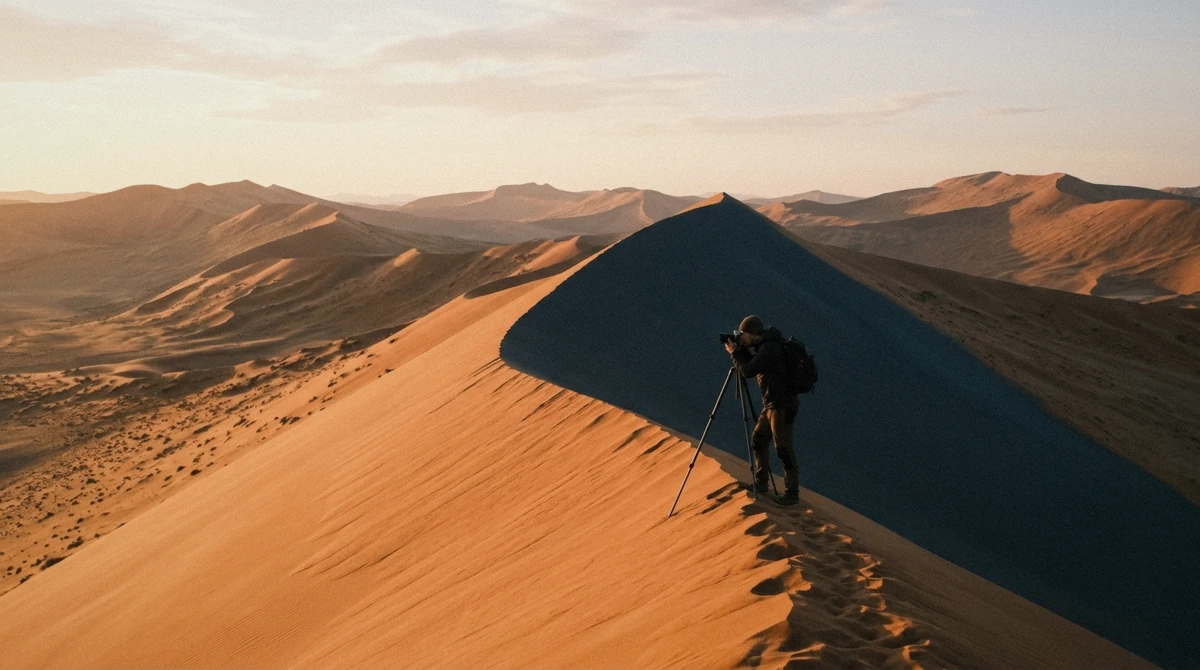
An hour of light worth setting an alarm for
Light Notes for 2026 Trips
The dune photography window is shorter than most people plan for: from roughly 45 minutes after the inner gate opens until mid-morning, the ridges carry hard shadow lines, and by noon the same frames flatten into haze. Sunrise slots from inside the gate give you Deadvlei with nobody in them; everyone arriving by shuttle after 10 shares the pan. A polarizer still does more for dune contrast than any filter stack.
For which weeks give that light reliably, see the best time to visit the Namib Desert.