What to Wear and Pack for the Namib Desert

What to wear Namib Desert trips demand is less one list than two, because you can be cold on the coast and overheated at Sossusvlei on the same calendar day. Tours handle the big items: the 4x4, the park permit, and on several Sandwich Harbour runs, lunch itself. What is left for you to pack is short, but it has to survive a 20-degree daily swing and a lot of dust.
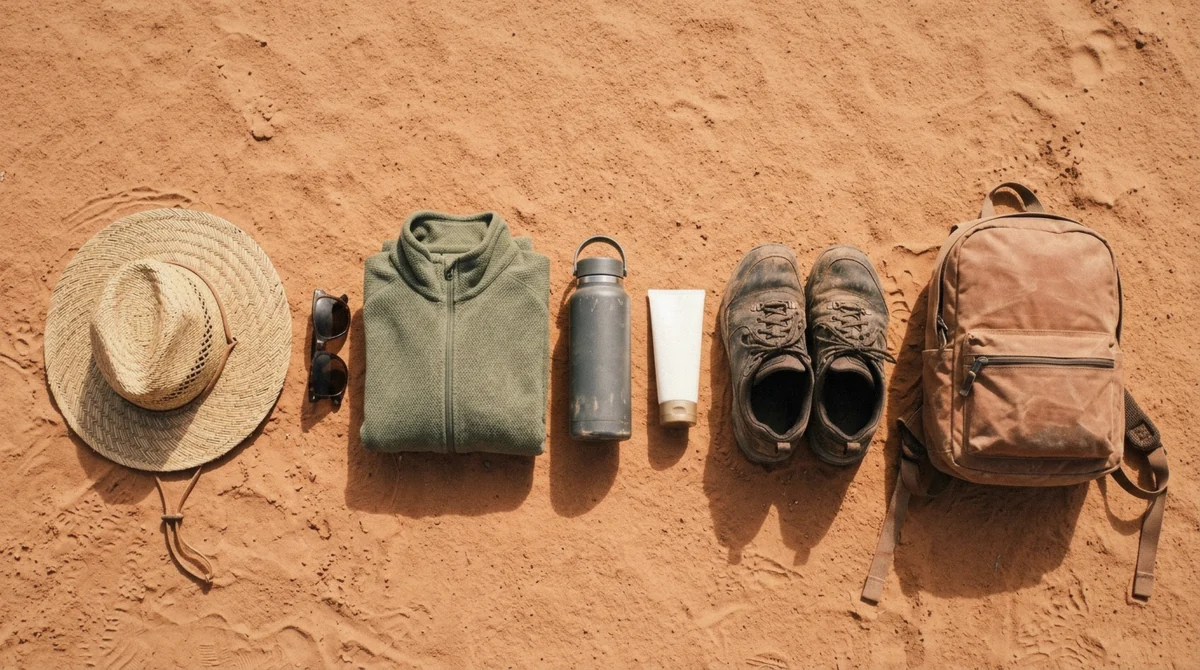
Everything that earns its space in a Namib Desert day bag: layers, not a costume change.
Quick answer
Tours provide the 4x4, the guide, the park permit and, on several Sandwich Harbour half-days, oysters and sparkling wine on the dune crest. What to wear in the Namib Desert comes down to layers: dune country can reach 40°C by early afternoon while the coast, a few hours away, sits at 15°C to 25°C under fog on the same morning.
Key takeaways
- Tours cover the vehicle, the permit and, on several coastal tours, food (oysters and sparkling wine on Sandwich Harbour half-days)
- Pack layers, not one outfit: coastal cold in the morning, dune heat by mid-morning
- Skip black and heavy cotton; earth tones and quick-dry fabric work better here
- Closed shoes for dune climbing, sandals for the vehicle and camp
- Winter mornings, June to August, bring frost on the gravel plains
- A windproof layer earns its place on every coastal tour, in every month
What to Wear in the Namib Desert
Dressing for a Pre-Dawn Start
Several of the best moments in this desert happen before sunrise: the balloon launch, the drive to Dune 45, the inner gate opening at Sesriem. All of them mean standing outside in 5°C to 9°C air well before the day's heat arrives.
Dress for then, and plan to peel layers off through the morning rather than dressing for the afternoon and shivering at departure. A base layer, a fleece and a windproof shell over the top gets you through the cold start; the shell comes off first, the fleece by mid-morning, and most people are down to a shirt by the time the balloon lands or the dune climb ends.
Layers, Not One Outfit
The single fact that decides your packing list is that the coast and the interior run two different climates on the same day. Dry-season days average about 27°C across the desert, with mornings dropping to 5°C to 7°C and frost forming on the gravel plains from June to August. Summer afternoons at Sossusvlei climb to 40°C, often by early afternoon, which turns a fleece from morning necessity to dead weight in your day bag within three hours.
The fix is layers you can shed on a schedule: a base shirt, a fleece or light mid-layer, and a windproof shell you can strip down to nothing by mid-morning and put straight back on the moment you reach the coast.
The Coastal Fog and the Benguela Current
Swakopmund and Walvis Bay run on a completely different rule than the dunes. The cold Benguela current keeps the coast between 15°C and 25°C all year, and it pushes fog up to 100 km inland on most nights, which is the reason a Sandwich Harbour morning can start grey and damp while Sesriem, a few hours inland, is already dry and climbing past 30°C.
That fog usually burns off by late morning, but the drive down to Sandwich Harbour runs along the beach with the ocean on one side, and the wind off the water does not wait for the sun. A windproof jacket is the one item every coastal itinerary needs regardless of month, more than sunscreen, more than a hat.
Sun Protection
The desert sun is direct and the glare off pale sand and salt pans is sharper than most travelers expect, especially near midday at Deadvlei's white clay pan. A wide-brimmed hat with a chin strap, wraparound sunglasses and a high-SPF sunscreen reapplied through the day matter more here than any specific outfit choice. A long-sleeve shirt in a light fabric does double duty against sun and wind and is cooler over a full day than repeated sunscreen application alone.
This matters even on an overcast coastal morning. Fog scatters UV rather than blocking it, so a grey sky at Walvis Bay is not a reason to skip sunscreen, only a reason it feels less urgent than it actually is.
Footwear
Closed athletic shoes or light hiking shoes are the right call for any dune climb. Big Daddy, the classic climb on Sossusvlei tours, runs 325 m of loose sand with no shade at any point on the way up, and bare feet or sandals both slow you down and burn on sun-heated sand by mid-morning. Trainers with a mesh upper that lets sand fall back out beat heavier boots here, since boots trap sand rather than shedding it.
Sandals or camp shoes cover everything else: the vehicle, the lodge, the evening. Flip-flops and unsecured sandals are the one footwear choice that does not work on a dune, since the sand gives way and a loose sandal is gone before you notice.
What to Bring for the Namib Desert
The Packing List
This is the short list that actually earns its space in a bag, sourced from what guides watch people forget or overpack on the coast and at Sesriem.
- Fleece or light jacket, mornings on the gravel plains run 5°C to 7°C from June to August
- Windproof shell, the coast holds wind and fog on every Sandwich Harbour run
- Wide-brimmed hat with a chin strap, wind off the dunes takes an unsecured one
- Closed athletic shoes, for the climb up Dune 45 or Big Daddy
- Sandals or camp shoes, for the vehicle, the lodge and the evening
- Wraparound sunglasses with UV protection, glare off the white pan at Deadvlei is sharp
- High-SPF sunscreen and lip balm, reapply through the day, desert air dries skin fast
- Two litres of water per person per activity, more on a hot October dune climb
- A buff or light scarf, dust on gravel roads gets into everything
- A sealed bag for camera gear, sand works into zippers and lens seams
- Small Namibian dollar notes, for tips and roadside stalls at Solitaire
- Blister plasters, dune sand finds every hot spot in a shoe within an hour
What Namib Desert Tours Provide, So You Don't Overpack
The Provide-Versus-Bring Table
Namib Desert tours from the coast already cover more than most first-time visitors expect, which is exactly why a packing list built without checking tour inclusions first tends to run long. Before you buy a single piece of new gear, check what the specific tour you booked already carries. The table below is built from what these particular tours actually include, not a generic guess at what a desert tour usually provides.
| Item | Usually provided | Bring your own | Notes |
|---|---|---|---|
| Park permit | Yes, on guided tours | No | Confirm at booking; self-drivers pay at the gate, see our full park fee breakdown |
| Food and drinks | Yes, on Sandwich Harbour half-days | No | Oysters and sparkling wine on the crest, including the half-day 4x4 excursion and the afternoon run with oysters |
| Hotel pickup | Yes, most Swakopmund and Walvis Bay departures | No | Confirm your pickup zone at booking, e.g. the Walvis Bay and Sandwich Harbour tour |
| 4x4 vehicle and driver | Always | No | The dune belt is not self-drive terrain outside a rented and permitted vehicle |
| Sandboarding gear | Only where listed | No | Bundled on the quad biking and sandboarding tour |
| Kayak and paddling gear | Yes, on the kayaking day | No | Included on the seals and Sandwich Harbour full-day |
| Drinking water | Usually | A refillable bottle is still worth packing | Confirm bottle count for a full-day drive before departure |
| Binoculars | Rarely | Yes, bring your own | Useful on the wildlife-stop 4x4 tour through the Kuiseb Delta |
| Shade at stops | Sometimes | Pack a hat regardless | Midday stops on the Namib-Naukluft landscape tour have little natural shade |
| Champagne breakfast | Yes, on the balloon flight | No | Part of the sunrise balloon over Sossusvlei |
What NOT to Wear or Bring in the Namib Desert
The Skip List
Heels, flip-flops and any sandal without a secured strap have no place on a dune climb. The sand gives way underfoot and a loose sandal disappears down the slope faster than you can turn around to retrieve it.
Leave valuable jewelry behind. Dust and salt spray are hard on rings, watches and clasps, and there is no jeweler at Sesriem or on the Sandwich Harbour route to fix a bent one.
Glass containers do not belong on a dune drive of any kind. A cracked bottle in a moving 4x4 on soft sand is a problem nobody wants to solve mid-tour.
Drones need a permit from Namibia's environment ministry, and flying one inside Namib-Naukluft or Etosha without one is the fastest way to have the gear held at a gate. If a camera, not a drone, is the point of your trip, our photo spots and timing guide covers what actually earns its place in a bag for that.
Skip a suitcase full of heavy cotton. It soaks with sweat on a hot dune climb and stays damp and cold on a foggy coastal morning, which is exactly the combination this desert is built to punish.
Don't overbuy before you land, either. Swakopmund has outdoor shops that stock hats, sunscreen and basic layers at fair prices, so a forgotten item is rarely a crisis worth an oversized suitcase to prevent.
A Color Guide for What to Wear
What Works and What Doesn't
Color choice matters more here than on most trips, mostly because of heat and glare rather than fashion.
| Color | Good? | Why |
|---|---|---|
| White | Good for heat | Reflects sun on a long dune walk, though it shows dust fast by afternoon |
| Black | Bad by day | Absorbs heat under a direct desert sun; fine after dark at camp |
| Bright or neon | Good on tours | Keeps you visible to your guide against tan sand and gravel |
| Camouflage pattern | Skip it | Not a legal restriction in Namibia, but it reads as costume, not practical fabric |
| Earth tones (khaki, olive, sand) | Good | Matches the wildlife-viewing norm at Etosha and hides dust well |
| Cotton, any color | Bad | Soaks with sweat on a climb and stays damp through a cold coastal morning |
| Quick-dry synthetic | Good | Dries between the sweat of a dune climb and the chill of the ride back |
Which Season You Are Packing For
If you are traveling May to October, the dry season
pack a fleece and windproof shell for 5°C to 7°C mornings, plus light layers for 27°C days
If you are traveling November to March, the green season
pack light long sleeves for sun rather than cold, and a rain shell for afternoon storms over the escarpment
If your trip includes the coast at any time of year
pack a windproof jacket regardless of season, since the Benguela current keeps Swakopmund and Walvis Bay at 15°C to 25°C
If you plan to climb Big Daddy or Dune 45
wear closed shoes with ankle support; 325 m of loose sand with no shade punishes bare feet and sandals alike
If you land in June, July or August
expect frost on the gravel plains at dawn and pack layers you can shed by mid-morning
Packing by Season in the Namib Desert
Dry Season, May to October
This is the coldest packing window by morning and the driest by day. A proper fleece and a windproof shell are not optional at dawn, especially for anyone on an open-vehicle Etosha game drive or a sunrise balloon flight. By ten in the morning the same person is usually down to a shirt.
Green Season, November to March
Heat, not cold, drives the packing list now. Days push past 30°C and reach 40°C at Sossusvlei by January, so sun protection matters more than layering. A light rain shell is worth the space for the escarpment storms that build most afternoons, even though they rarely reach the dunes themselves.
Every Month, on the Coast
Swakopmund and Walvis Bay do not follow the interior's calendar. A windproof jacket belongs in every bag in every month, because fog and wind off the Benguela current show up on their own schedule, not the season's. For the exact month-by-month breakdown behind this table, see our full guide to the best time to visit the Namib Desert.
| Season | Wear this |
|---|---|
| Dry season mornings (May-October) | Fleece, windproof shell, closed shoes, a beanie for open vehicles |
| Dry season afternoons (May-October) | Light shirt, sun hat, sunglasses, sunscreen |
| Green season (November-March) | Long light sleeves for sun, rain shell, closed shoes for dune climbs before the day heats up |
| Coast, any month | Windproof jacket, closed shoes for the beach route, layers you can peel off inland |
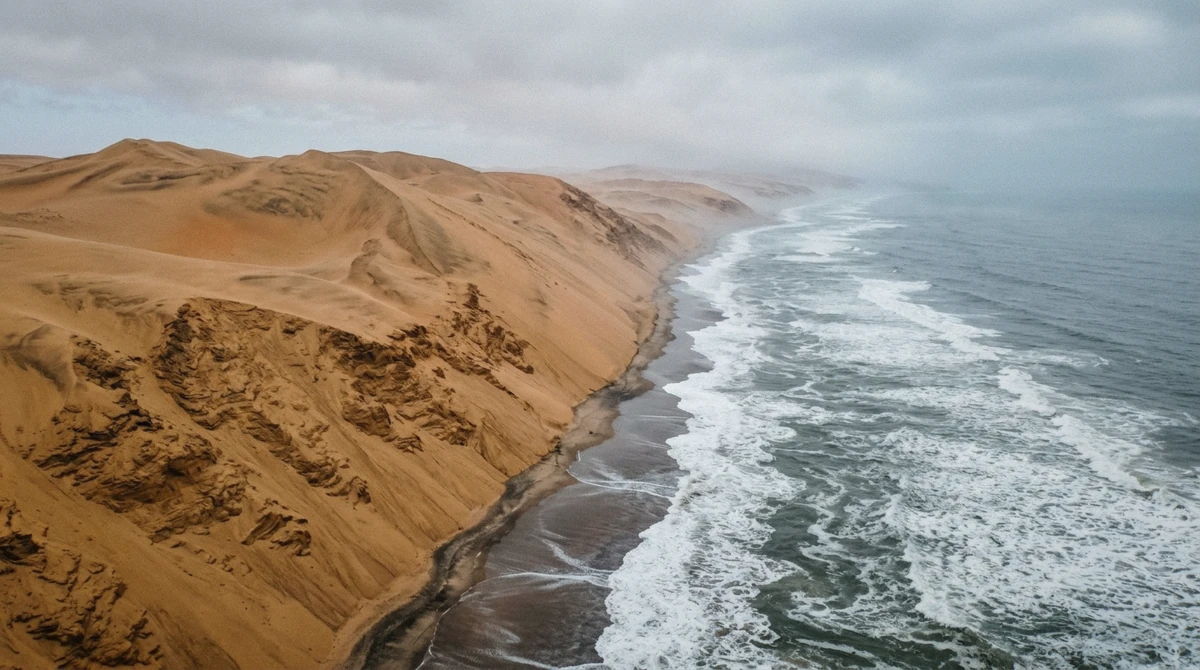
The one item every Sandwich Harbour trip needs regardless of season: something that blocks the wind.
Questions About What to Wear in the Namib Desert
What should you wear in the Namib Desert?
Layers you can shed through the morning: a base shirt, a fleece or light mid-layer for the cold start, and a windproof shell for the coast. Closed shoes for any dune climb, sandals for everything else, and sun protection year-round.
How cold is the Namib Desert at night?
Dry-season mornings, May to October, run 5°C to 7°C, with frost on the gravel plains from June to August. Nights on the coast stay milder, closer to 12°C to 15°C, because the ocean moderates the temperature there.
Can you wear shorts in Namibia?
Yes, on hot afternoons or a coastal walk, in a quick-dry fabric rather than cotton. For a dune climb, long light trousers or leggings protect better against sun and hot sand, so shorts are a comfort choice, not a requirement either way.
Can you wear black in Namibia?
Not for daytime activity. Black absorbs heat under a direct desert sun and makes a dune climb harder than it needs to be. It is fine for an evening at camp once the temperature has dropped.
Can I wear jeans in the Namib Desert?
Not as your main layer. Jeans do not dry between a sweaty climb and a cold coastal morning, and they restrict movement on loose sand. A quick-dry trouser does the same job better in both climates.
What should you not bring on a desert tour?
Heels or unsecured sandals, valuable jewelry, glass containers, a drone without an environment ministry permit, and a suitcase built around heavy cotton. None of them hold up to sand, wind or a 20-degree swing in temperature.
Does the tour provide any gear or food?
It depends on the tour, but several do. Sandwich Harbour half-days commonly include oysters and sparkling wine on the dune crest, and every guided tour includes the 4x4, the driver and the park permit.
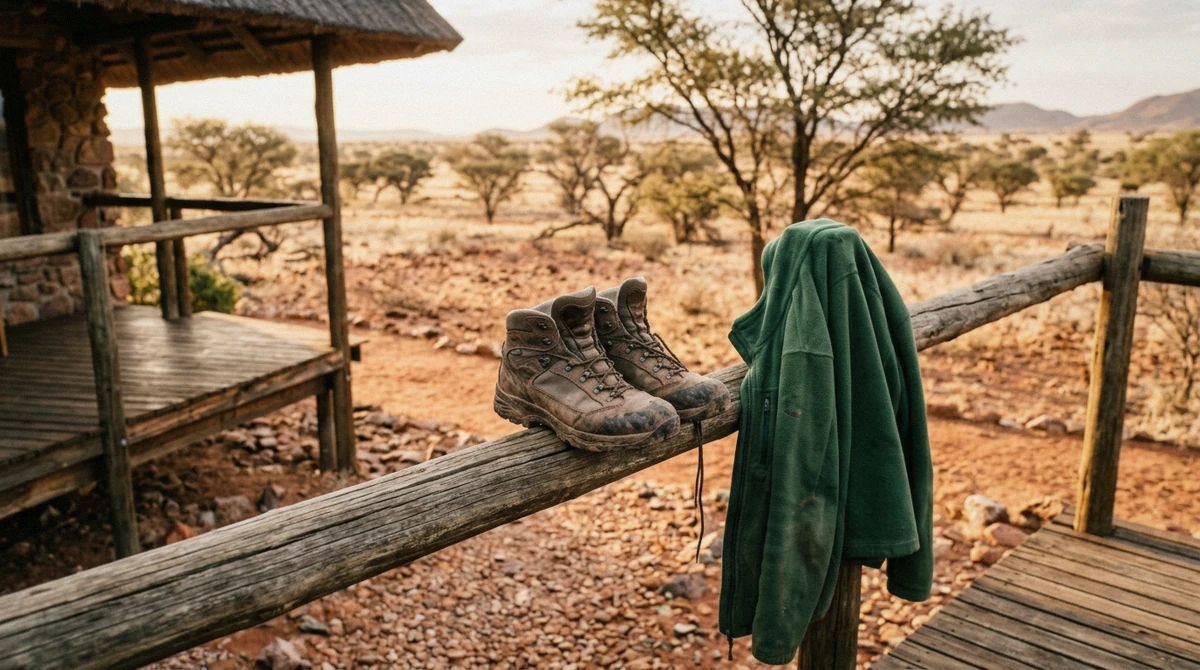
The same bag, two different seasons
Seasonal Swaps for 2026 Trips
The packing core on this page works year-round; what changes is the two ends of the day. From December to March, swap the heavy fleece for a light long-sleeve and trust that nights stay warm enough for a shell jacket. From May to August, frost on the morning drive is normal and gloves matter more than a second pair of socks.
Month-by-month temperature swings are in the best time to visit the Namib Desert guide.