What Is So Special About the Namib Desert?

The Namib Desert is special because it has stayed arid for at least 55 million years, which makes it the oldest desert on Earth, and because it is the only coastal desert with extensive fog-shaped dune fields, according to UNESCO. If you are asking what is so special about the Namib Desert before you book, this page covers the fog, the 325 m dunes, Deadvlei's dead trees, where the sand meets the ocean and which day trip shows each one.
Quick answer
The Namib Desert is special because it is the oldest desert on Earth, arid for at least 55 million years, and the only coastal desert in the world with extensive dune fields shaped by fog, according to UNESCO. Its star dunes reach about 325 m, its dead camel thorn trees at Deadvlei have stood for centuries, and its animals drink fog. The easiest way in is a Sandwich Harbour 4x4 half-day or a Sossusvlei and Deadvlei day.
Key takeaways
- At least 55 million years of aridity, the reason the Namib is called the oldest desert on Earth
- Fog, not rain, feeds life here: up to 100 km inland on most nights, against 2 mm to 104 mm of rain a year
- Star dunes of about 325 m at Sossusvlei, the tallest with a sourced measurement (see the Dune 7 question)
- Deadvlei's camel thorn trees died centuries ago and never rotted because the air is too dry
- Sandwich Harbour is where dunes of about 100 m drop straight into the Atlantic, 42 km south of Walvis Bay
- A park day costs N$280 per foreign adult (about $16), and the full cost breakdown shows what else to budget
Namib Desert Tours That Show You Why It Is Special
Three days out that cover the desert's best-known features, from the coast where dunes meet the ocean to Sossusvlei and Deadvlei. Prices are per person in USD as listed by the operator, and each card shows that operator's own rating.
 from $127
Sandwich Harbour Half-Day 4x4 Scenic Excursion
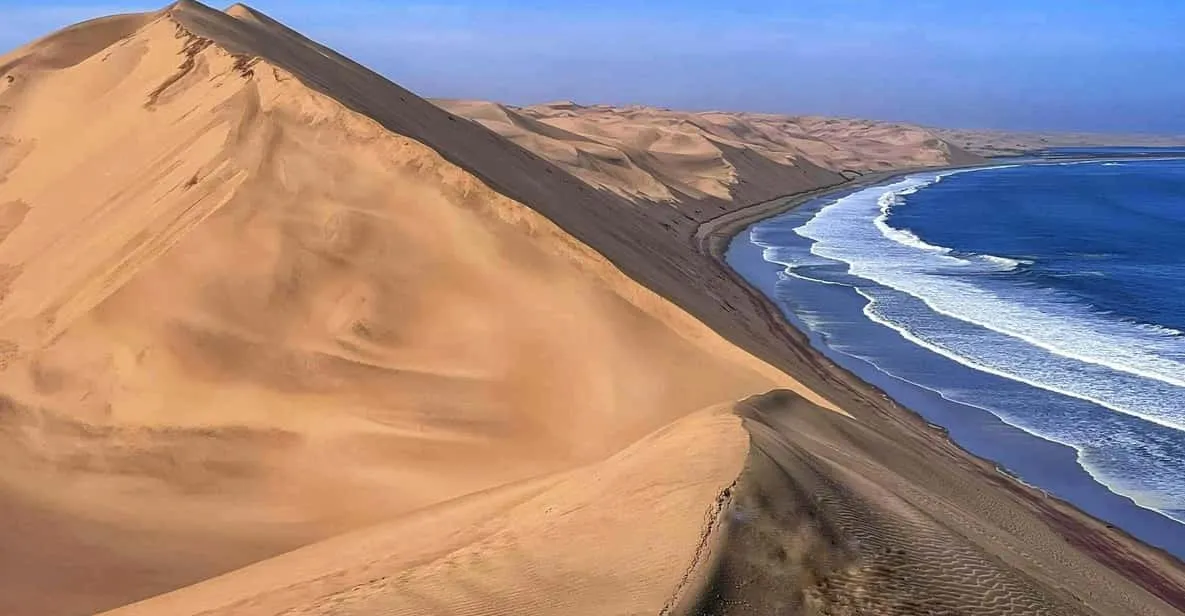
The highest-rated way to reach the harbour: lagoon and salt pans first, then the beach run and a climb onto dunes that fall straight into the Atlantic. Oysters and sparkling wine on the crest.
Check Availability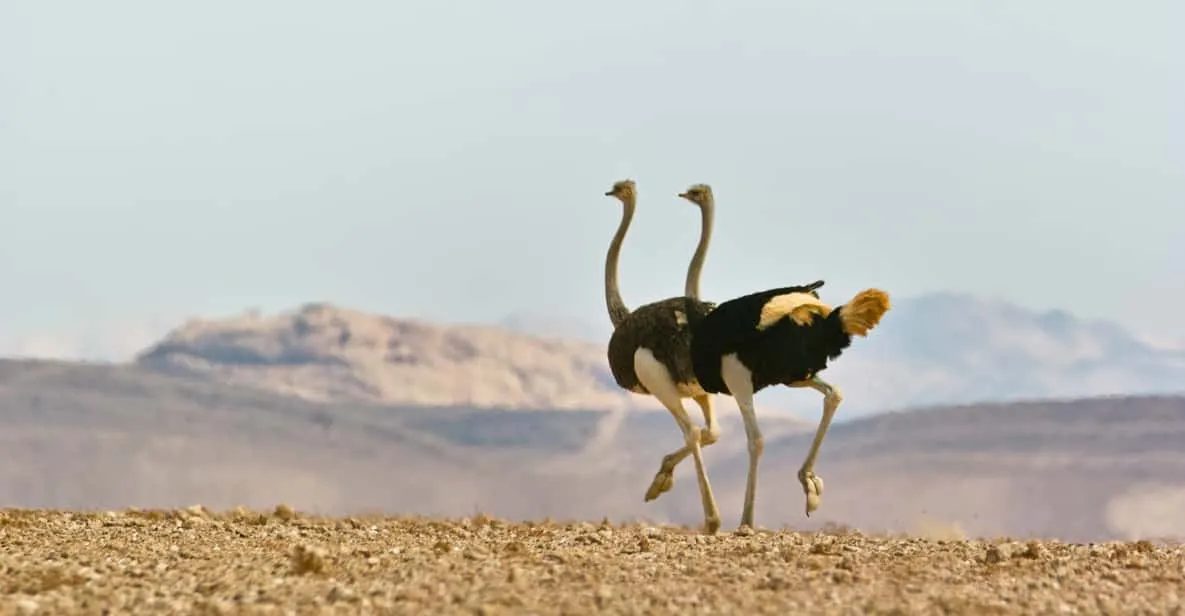 from $300
Namib-Naukluft Park Landscapes and Wildlife Day Tour
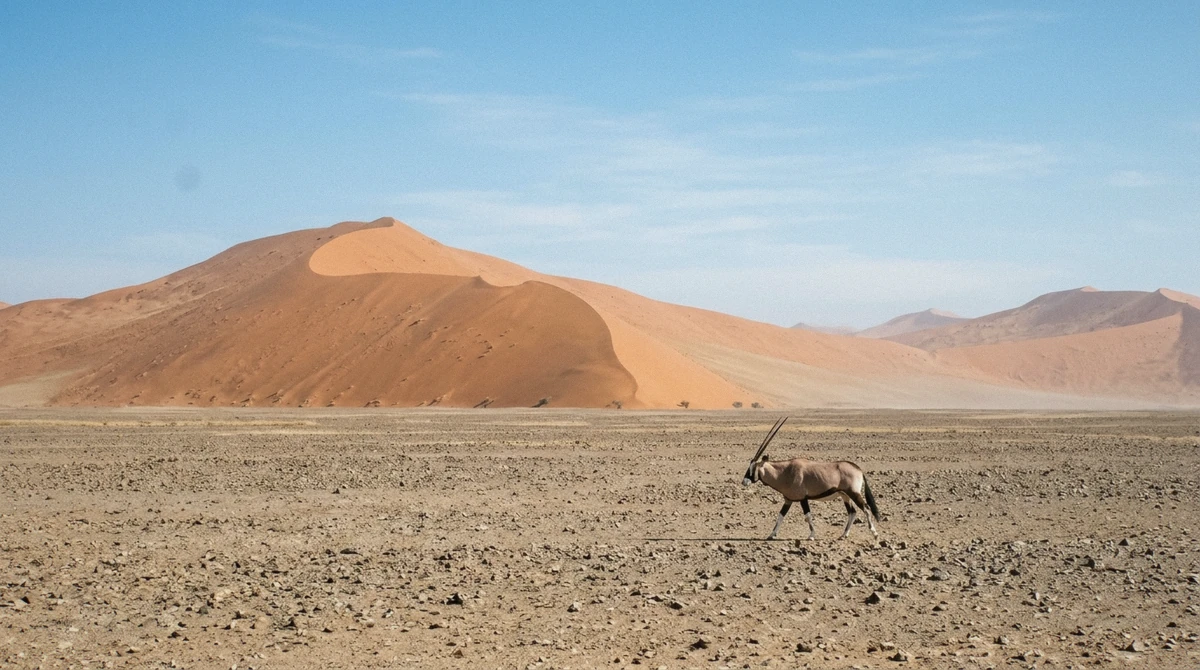
A photographic day through the Namib-Naukluft moonscape and mountains, with oryx, zebra, springbok and jackal along the route.
Check Availability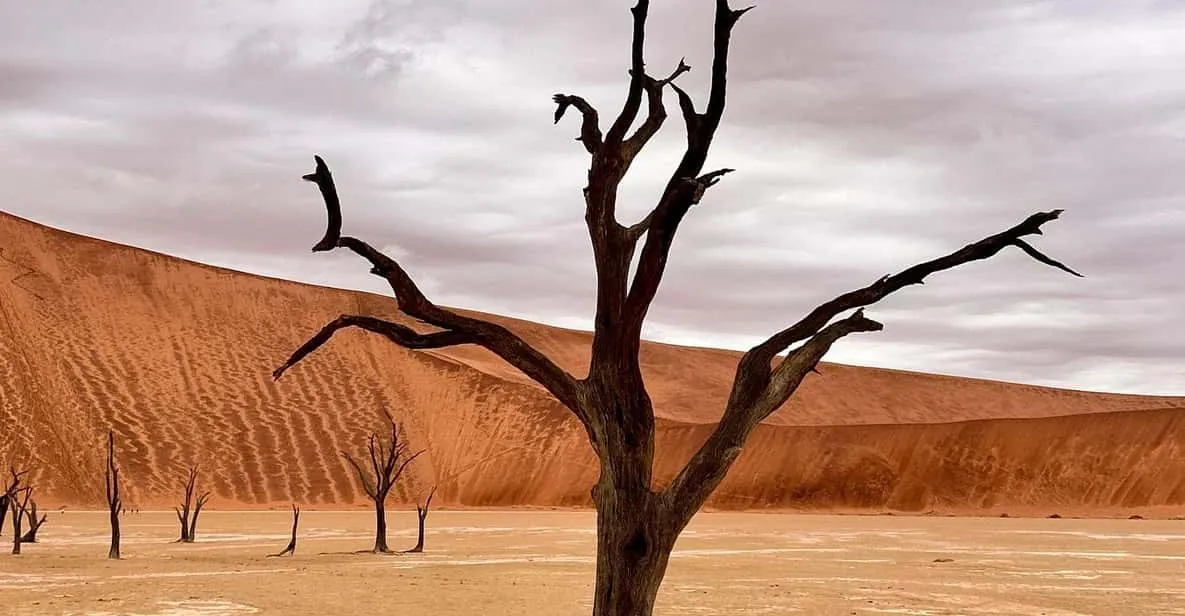 from $430
Sossusvlei and Deadvlei Full-Day Trip
Dune 45, Deadvlei and Sesriem Canyon in one long day. Early start, because the dunes are only comfortable before mid-morning.
Check AvailabilityWhat Is So Special About the Namib Desert?
Four things set it apart. It is among the oldest deserts on Earth. It is a coastal desert, so cold Atlantic fog reaches the dunes almost every night. It holds a sand sea that UNESCO calls the only coastal desert in the world with extensive dune fields influenced by fog. And its dunes are among the tallest in the world, with star dunes rising to about 325 m. The table puts the main claims next to the figure and where it comes from.
The Namib is also a protected landscape of unusual size. UNESCO inscribed the Namib Sand Sea in 2013 with a core zone of 3,077,700 hectares and a buffer zone of 899,500 hectares, inside the Namib-Naukluft Park. Access is by permit and by few roads, which keeps the dunes close to untouched.
| What is special | Figure | Source |
|---|---|---|
| Time spent arid | At least 55 million years | Geological dating summarised in the Namib overview |
| UNESCO core zone | 3,077,700 hectares (2013) | UNESCO |
| Sand sea area | About 34,000 km² | IUGS Geoheritage |
| Tallest dune with a measured height | About 325 m (Big Daddy, Sossusvlei) | NASA Earth Observatory |
| Rain at Sossusvlei | About 104 mm a year | Site figure, see best time to visit |
| Fog reach inland | Up to 100 km | Site figure, see what to pack |
Source: UNESCO, Namib Sand Sea, IUGS Geoheritage, Namib Sand Sea, NASA Earth Observatory, Namib Sand Sea.
What Is the Oldest Desert on Earth?
The Namib is usually named as the oldest desert on Earth because it has stayed dry or semi-dry for at least 55 million years, and some estimates run to 80 million. The cause is the cold Benguela current offshore, which cools the air above it so much that onshore winds carry fog rather than rain. That setup has not changed for tens of millions of years.
Compare it with the Sahara. The Sahara has greened and dried several times in the same span, so its present dunes are far younger than the desert's age suggests. Do not confuse the age of the desert with the age of the sand. Cosmogenic dating puts the Namib Sand Sea at more than a million years old, and NASA describes the sand of Dune 45 as about 5 million years old. The sand was carried here, not made here: the Orange River is the predominant source, the ocean current moves it north, and southerly winds blow it inland.
The practical consequence for a visitor is simple. Plants and animals did not adapt to a drought in the Namib, they evolved inside one. That is why the oryx, the welwitschia and the dune beetles look unlike anything on a safari in the north of the country.
Source: IUGS Geoheritage, Namib Sand Sea, NASA Earth Observatory, Namib Sand Sea.
What Are Three Things That Are Strange About the Namib Desert?
The strangest three are animals that drink fog, trees that died centuries ago and never rotted, and a river that never reaches the sea. Each one is visible on a day trip, and each has a clean explanation.
First, fog is drinking water. Beetles stand head-down on dune crests at dawn and collect condensation on their backs, and the web-footed gecko licks fog off its own eyes. Second, Deadvlei holds a white clay pan with camel thorn trees that died centuries ago and still stand, because the air is too dry for the fungi that break down wood. Third, the Tsauchab River flows toward the dunes and ends in the Sossusvlei pan without ever reaching the ocean. The pan floods only every few years, usually between February and April.
The table lists the residents you have a fair chance of meeting, with the trick each one uses to live here.
| Species | Where you see it | The trick |
|---|---|---|
| Oryx (gemsbok) | Gravel plains, Namib-Naukluft | Goes without drinking and lets its body run to 45°C (113°F) before it sweats |
| Web-footed gecko | Dune belt after dark | Licks fog off its own eyes |
| Peringuey's adder | Dune slipfaces | Moves through loose sand and leaves a looped sidewinder track |
| Welwitschia | Gravel plains east of Swakopmund | Grows only two leaves in its whole life, specimens over 1,000 years old |
| Lesser flamingo | Walvis Bay Lagoon | Up to 50,000 birds at the peak |
Source: UNESCO, Namib Sand Sea, IUGS Geoheritage, Namib Sand Sea.
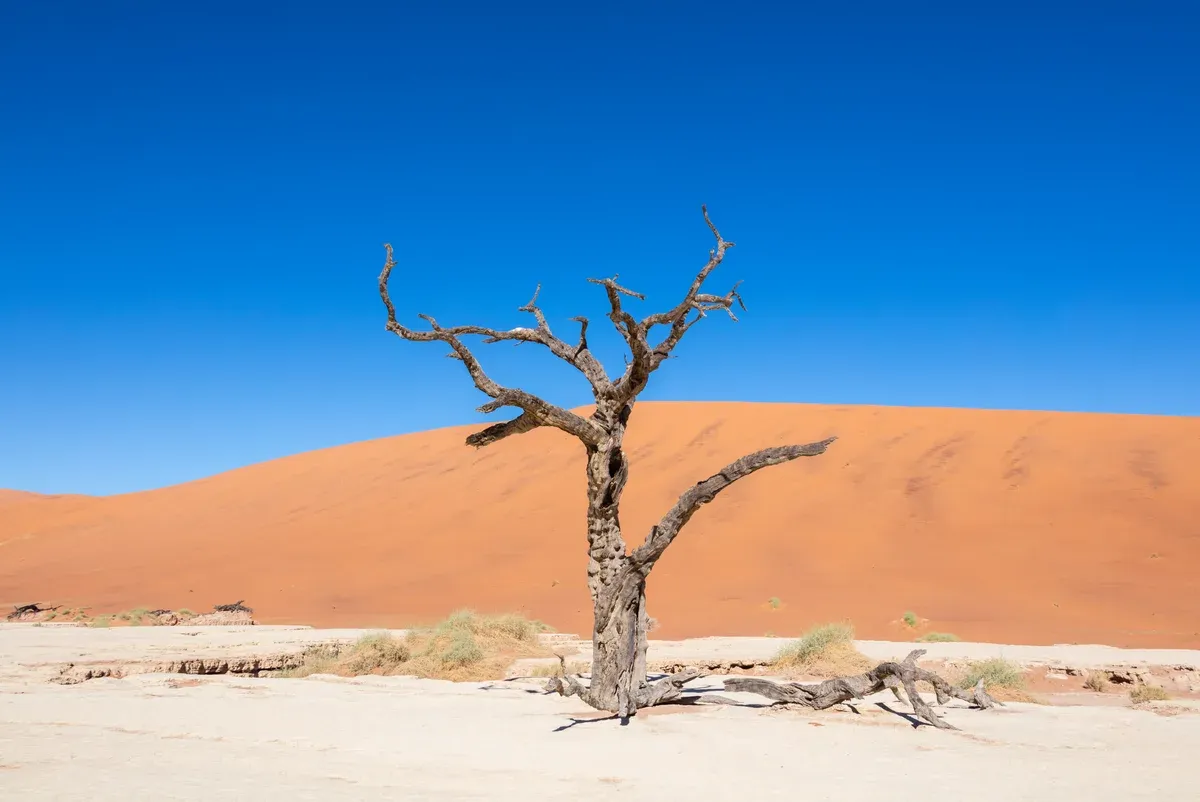
Deadvlei. Photo: Diego Delso, CC BY-SA 4.0, via Wikimedia Commons
How Does Fog Keep the Namib Desert Alive?
Fog is the water source for most of the desert's life. The Benguela current pushes a fog bank over the coast on most nights, and it reaches up to 100 km inland. The inner Namib can go as low as 2 mm of rain in a year, and Sossusvlei averages about 104 mm, nearly all of it between February and April. Against that, a night of fog gives beetles, lichens, geckos and welwitschia something to drink every week.
The same current explains why the coast feels nothing like the dunes. Swakopmund and Walvis Bay sit at 15°C to 25°C (59°F to 77°F) all year and are often grey by morning. Sossusvlei, about 350 km southwest of Windhoek in the inner Namib, reaches 40°C (104°F) on a summer afternoon. If you pack for one, you will be wrong for the other, so the packing list for the Namib covers both.
One more point for anyone who dislikes mornings. Fog burns off the dunes early, and the light before 9 am is when the colour is strongest and the sand is cool enough to climb.
Why Do the Namib Dunes Grow So Tall?
Three ingredients explain the height: a huge supply of sand, steady winds from more than one direction, and millions of years to pile it up. The sand started in the Orange River catchment, travelled north along the coast with the ocean current and was blown inland by southerly winds. The IUGS Geoheritage listing records linear dunes taller than 150 m and star dunes taller than 300 m.
Star dunes are the giants. They form where winds change direction, so the sand piles upward in several arms instead of marching sideways. Big Daddy at Sossusvlei is a star dune of about 325 m above the pan floor, and the Goudie and Viles chapter on Namib dunes gives the same ceiling of about 325 m. Big Mama, facing it across the pan, is about 300 m. Dune 45 is far smaller at about 80 m, which is why people actually climb it.
For the full dune-by-dune comparison, including the disputed figure quoted for Dune 7 near Walvis Bay, read is Dune 7 the highest dune in the world.
Source: IUGS Geoheritage, Namib Sand Sea, NASA Earth Observatory, Namib Sand Sea, Goudie and Viles, Springer.
What Is Deadvlei and Why Do Its Trees Not Rot?
Deadvlei is a white clay pan about 2 km from Sossusvlei, ringed by dunes and holding dead camel thorn trees. The trees died centuries ago, after the Tsauchab River stopped reaching the pan. They never rotted because the air is too dry for the fungi that normally break down wood.
Walk in early. From the 2x4 parking the walk across the pan takes about 20 minutes and has no shade. Closed shoes matter because the sand burns bare feet by mid-morning. Big Daddy, the 325 m dune beside it, takes 45 to 60 minutes up and about three minutes to run down into the pan, which is the best-known thing to do here.
Beyond the trees, the pan is the clearest picture of how the Namib works. A river fed the place once, and then the water stopped coming. The photo spots that make the best use of the early light are in the Namib photo spots guide.
Where Does the Namib Desert Meet the Ocean?
At Sandwich Harbour, 42 km south of Walvis Bay, where dunes of about 100 m drop straight into the Atlantic. The beach between the dunes and the surf is the only route in, and it is passable for a few hours around low tide. Low water shifts about 50 minutes later each day, so guides plan around the tide table.
The area sits inside the Namib-Naukluft Park, a permit is required and access is limited to licensed operators, so there is no self-drive version. The lagoon at the end stays fresh because groundwater seeps out at the foot of the dunes. Just north, the Walvis Bay Lagoon is Ramsar site 742, listed on 23 August 1995, with over 150,000 birds and flamingo numbers peaking near 50,000.
This is the part of the Namib that works all day in summer, because the fog keeps the coast cool. The Sandwich Harbour 4x4 tours compare the half-day, sunset and kayaking options.
Source: UNESCO, Namib Sand Sea, Ramsar Sites Information Service, Walvis Bay.
How Do You See the Namib Desert Without Wasting a Day?
Match the day to what you came for. Sossusvlei and Deadvlei need a dawn start, so sleep inside the gate or book a tour that leaves in the dark. The park gate at Sesriem opens at sunrise and the desert access gate opens near sunrise and closes one hour after sunset, per Namibia Wildlife Resorts. Dune 45 sits 45 km inside the gate along 60 km of tar, and the last 6 km to the pan is deep sand that needs a 4x4 or a shuttle.
In Namibian summer, November to February, the dunes are comfortable only until about 9 am, so the dawn start is not optional. The coast needs no early start. The table shows what each option costs and what it gives you.
| Day | What you see | Length | From |
|---|---|---|---|
| Sandwich Harbour half-day 4x4 | Dunes meeting the ocean, flamingos, oryx | 4 hours | $127 |
| Namib-Naukluft landscapes day | Gravel plains, wildlife, desert scenery | 7.5 hours | $300 |
| Sossusvlei and Deadvlei full day | Dune 45, Big Daddy area, Deadvlei | 14 hours | $430 |
| Sunrise balloon over Sossusvlei | The dune sea from above | 1 hour aloft | $1,087 |
Source: Namibia Wildlife Resorts, Sesriem gate times, Government Gazette No. 8877.
How Much Does Seeing the Namib Cost?
Park fees are N$280 per foreign adult per day, about $16 at N$17.5 to the dollar, plus N$60 for a vehicle of ten seats or fewer, per Government Gazette No. 8877. Children over 8 and under 16 pay N$180, and children aged 8 and under are free. Tours usually include the fees, so read the listing before adding them twice. Everything else about what the money buys, from the shuttle to fuel and lodges, is in Namib Desert tour cost, and if you are deciding between a tour and a rental car, self-drive versus guided sets the two side by side.
If you are comparing options across the whole desert, the Namib Desert tours page lists every day on one screen.
Source: Government Gazette No. 8877.
Questions About the Namib Desert
What is so special about the Namib Desert in one sentence?
It is the oldest desert on Earth, kept dry by a cold ocean current and fed by fog, with dunes of about 325 m and a UNESCO-listed sand sea of 3,077,700 hectares.
Is the Namib Desert really 55 million years old?
The desert has stayed arid for at least 55 million years and possibly 80 million. The sand itself is much younger, with the sand sea dated at more than a million years and Dune 45's sand at about 5 million.
Which country is the Namib Desert in?
Namibia. It runs about 2,000 km down the Atlantic coast and crosses into southern Angola and the Northern Cape of South Africa at either end. Every Namib Desert tour here starts in Namibia.
Can you swim or drive on the beach at Sandwich Harbour?
You cannot drive it yourself. The beach is the only route and opens for a few hours around low tide, so only licensed operators run it, for example the 4x4 half-day.
How hot does the Namib Desert get?
Sossusvlei reaches 40°C (104°F) on a summer afternoon, while the coast stays at 15°C to 25°C (59°F to 77°F) all year. Winter nights on the plain fall to about 10°C (50°F).
What is the best way to see the dunes?
Start before sunrise. A Sossusvlei and Deadvlei day or a night inside the gate gets you to Dune 45 and Deadvlei in the cool hours. See how to get to Sossusvlei for the road.
Where should I sleep to start early?
Sesriem is the closest base to the dunes. The options are in where to stay near the Namib Desert.